Playful Cat Line Art Set with Palm Tree
A Designer’s First Look: Light, Lively, and Just Right for Handmade Charm
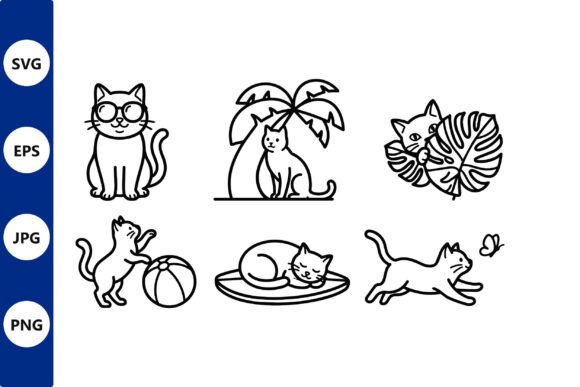
Opening the Playful Cat Line Art Set with Palm Tree, I immediately felt that familiar spark — the kind you get when a design lands somewhere between whimsy and wearability. Five cats in clean black-and-white line art, each with distinct posture and personality, grouped with a single palm frond and a simple ball. No shading, no gradients, just confident strokes and intentional negative space. It’s not “cute overload” — it’s relaxed, breezy, and quietly confident. That makes it ideal for embroidery projects where clarity matters more than complexity: think tote bags for a local café, baby onesies for a boutique, or linen tea towels for a small shop launch.
How It Stitches Up: Where This Design Truly Shines
I tested one cat + palm motif on a medium-weight cotton canvas tote using a standard 4″ hoop and medium-cutaway stabilizer. The result? Crisp, legible lines at 8–10 stitches per mm — no bleeding, no thread nesting, and zero need for satin stitch fill. Because it’s line art, the Playful Cat Line Art Set with Palm Tree works beautifully as a running stitch outline or light fill stitch, keeping stitch density low and production time manageable. That’s gold for Etsy sellers juggling custom orders or craft fair prep.
It landed especially well on sweatshirt embroidery — the open shapes let the fabric breathe, so the design doesn’t feel stiff or bulky. On baby embroidery, the simplicity reads clearly even at 3.5″ wide, and parents appreciate how easy it is to read the cats’ expressions without tiny details getting lost in stitching. As an embroidered patch, it holds up after multiple washes because there are no fragile interior corners or micro-loops. And for holiday embroidery — say, on a linen pillow cover for a tropical-themed gift — the palm element adds subtle seasonal flair without leaning into cliché.
Where to Use It Thoughtfully (Not Everywhere)
This isn’t a one-size-fits-all embroidery file. Its strength is its simplicity — but that also means it needs thoughtful placement. Avoid cramming it into hoops smaller than 3″: the ball and leaf tips start to blur, and fine line integrity suffers. On textured fabrics like terry cloth or bouclé, test first — those subtle curves can soften or break if the needle skips across uneven surfaces. Thin or stretchy fabrics (think lightweight knits or rayon blends) need extra stabilization; otherwise, the lines may pucker or distort under tension.
Dark fabric demands attention too. Since the original is black-and-white line art, contrast relies entirely on thread choice. A white thread on navy works — but a light gray thread might disappear. Always test thread colors on scrap fabric, especially if you’re planning a batch of personalized gifts or small shop products. And skip curved surfaces like caps unless you’re using a cap frame: the palm frond’s gentle arc can warp slightly on domed areas without proper hooping technique.
What It Adds to Your Finished Product — Beyond the Stitch
The Playful Cat Line Art Set with Palm Tree elevates handmade presentation without shouting. It feels intentional, not generic — which builds customer trust faster than over-designed clipart ever could. Buyers notice when a design has rhythm and breathing room, and that translates directly to perceived value. On an Etsy listing, this set supports strong printable mockups: its clean outlines render sharply in digital previews, helping shoppers visualize it on their own sweatshirts or kitchen towels before buying.
For creative entrepreneurs building brand consistency, the cohesive theme — cats + palm + ball — offers natural expansion: use one cat solo for a minimalist cap, group two for a patch set, or layer the palm frond behind text for a boutique logo. It’s flexible enough for commercial embroidery but distinctive enough to avoid looking mass-produced. And because it’s rooted in illustration rather than photorealism, it scales cleanly across product types — from a tiny embroidered tag on a handmade soap wrap to a bold 6″ version on a picnic blanket.
Practical Notes Every Embroidery Designer Should Check
- Test first: Run a sample on your exact fabric + stabilizer combo before committing to client work or inventory.
- Review stitch density: Even though it’s line art, some machines interpret thin paths differently — check your software preview for unintended overlaps or gaps.
- Confirm hoop size compatibility: While the designs are individual, verify the largest cat fits comfortably within your most-used hoop before digitizing or resizing.
- Inspect small details: Zoom in on the ball and palm tip in your embroidery software — make sure no stray nodes or anchor points will cause jump stitches.
- Mock it in black and white: View your design on light and dark backgrounds digitally — helps anticipate thread contrast issues before stitching.
- Stabilizer matters: Medium cutaway works best for woven fabrics; switch to tear-away for stable knits, and always match stabilizer weight to fabric drape.
- Licensing check: Since this is a digital embroidery file sold as Graphics, confirm whether commercial use is permitted for finished products or resale of derivative designs — review the seller’s terms before listing on Etsy or using in client branding.
Final Thought: A Quietly Versatile Asset for Real Work
The Playful Cat Line Art Set with Palm Tree won’t dominate your portfolio — and it shouldn’t. It’s the reliable, sunlit accent piece: the kind of design that makes a baby onesie feel special, turns a plain apron into a conversation starter, or gives a small shop’s holiday collection a cohesive, hand-drawn warmth. It’s not flashy, but it’s functional. Not complicated, but considered. For embroidery designers, craft business owners, and makers who value clarity over clutter, it’s a quietly powerful addition to your design assets — ready for real projects, real customers, and real life.