Forest Botany Line Art SVG: Botanical Graphics & Illustrations
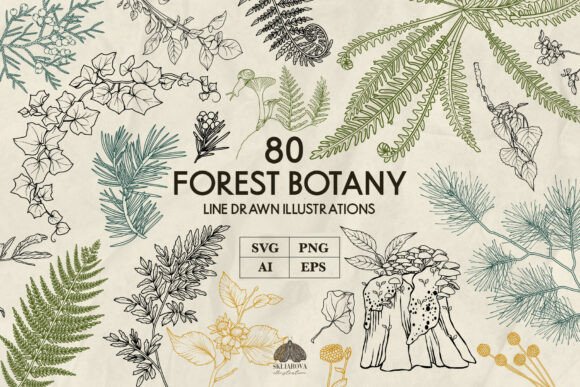
As a brand designer who’s developed visual identities for over two dozen local businesses—from hand-poured candle studios in Asheville to organic baby skincare brands in Portland—I opened Forest Botany Line Art SVG expecting delicate, intentional line work. What I found was something more valuable: a cohesive, hand-drawn botanical language that breathes quiet confidence. This isn’t clipart. It’s a curated set of 80 forest-inspired elements—ferns, mushrooms, sprigs of pine, birch branches, trailing ivy, seed pods, and mossy textures—all drawn with subtle variation in line weight and organic rhythm. The mood is grounded, gentle, and quietly sophisticated: neither overly rustic nor sterilely modern. It suggests authenticity without trying too hard—a perfect fit for small business branding where customers seek sincerity over slickness.
Why This Set Fits Real Local Business Branding—Not Just Design Trends
I recently used Forest Botany Line Art SVG for the rebrand of “Hearth & Thyme,” a Portland-based handmade soap and herbal tea shop serving neighborhood farmers’ markets and local boutiques. Their existing packaging felt generic—stock floral patterns that lacked regional character or tactile warmth. With this set, we anchored their entire brand identity in Pacific Northwest forest ecology: not as decoration, but as narrative. A single fern motif became the unifying element across soap labels, thank-you cards, seasonal gift tags, and Instagram story highlights. Because every element is hand-drawn—not algorithmically generated—the lines carry human nuance: slight tapering, soft endpoints, and irregular spacing that reads as *made*, not manufactured. That distinction builds immediate trust with customers who value craftsmanship and local provenance.
Where It Elevates Packaging, Labels, and Promotional Visuals
This set shines brightest where small business branding meets tangible customer experience:
- Product labels: Use individual sprigs or clusters as elegant borders or corner accents on apothecary-style soap or honey jars—especially effective when printed in muted sage, charcoal, or cream on kraft paper.
- Packaging design: Scale larger elements (like a full birch branch or layered fern frond) as background textures on shipping boxes or gift wrap—vector scalability ensures crisp reproduction at any size.
- Social media graphics: Layer clean SVG elements over product mockups for Instagram carousels or Pinterest pins—no pixelation, no color limits.
- Printable design & marketing visuals: Print thank-you cards with a subtle mushroom motif watermark; use a single pinecone as a bullet point in a seasonal newsletter; add trailing ivy to price lists or menu boards for cafés or florists.
- Seasonal campaign visuals: Combine elements for autumn harvest bundles (acorns + oak leaves), spring launches (fiddleheads + wild violets), or winter gifting (holly berries + cedar boughs).
Where It Builds Brand Strength—Beyond Aesthetics
Using Forest Botany Line Art SVG consistently across touchpoints does more than look nice—it strengthens core brand fundamentals. On shelf, it improves product recognition through distinctive, ownable botanical cues. In digital spaces, it creates clearer visual hierarchy: a hand-drawn fern beside bold serif typography guides the eye more intentionally than generic stock icons. For local businesses competing against national brands, that consistency signals professionalism and care—key drivers of customer trust. And because all files are vector-based (SVG, AI, EPS), we maintained absolute fidelity from 8mm hang tag to 48" in-store banner—no redraws, no compromises. That reliability directly translates to stronger shelf appeal and more polished marketing visuals.
Where to Use It Thoughtfully—Not Everywhere
This set excels as supportive illustration—not dominant branding. Avoid using it for:
- Primary logo design (it’s decorative, not foundational);
- Very small labels (under 12mm height)—some fine details may blur in print);
- Crowded ingredient-heavy layouts (e.g., USDA-certified food labels with dense regulatory text);
- Backgrounds with low-contrast colors (test PNG transparency carefully on light greys or beiges);
- Luxury minimalist brands relying on negative space—here, the organic density can feel busy rather than serene.
Practical Brand Designer Notes Before You Launch
Before finalizing any design using Forest Botany Line Art SVG, always:
- Test it on real packaging mockups—not just screen previews;
- Check black-and-white output for clarity (some delicate lines fade on thermal printers);
- Preview scaled-down versions on actual label sizes;
- Test color flexibility: overlay elements on your brand palette (does a charcoal fern read clearly over warm terracotta? Does mint green hold on recycled kraft?)
- Compare against top 3 local competitors’ packaging—does it differentiate, not echo?
- Verify print quality with your vendor: request a physical proof of a complex layer (e.g., fern + script font + foil stamp)
- Inspect SVG editability: can you isolate stems from leaves? Adjust stroke width without distortion?
- Test alongside your full type system—serif, sans serif, script, handwritten—and confirm legibility doesn’t suffer;
- Confirm commercial license covers physical product sales, client work, and digital distribution (this set includes proper commercial rights for small business branding and product packaging).
When chosen with intention, Forest Botany Line Art SVG becomes more than a graphic design asset—it becomes part of a brand’s voice. For local business owners, handmade sellers, and creative entrepreneurs building something real, that kind of thoughtful, scalable, emotionally resonant illustration doesn’t just fill space. It tells customers, quietly and confidently: This was made here. With care. For you.