Cactus Line Art Clipart for Crafts & Graphics
As a graphic designer who’s built brand identities for over a dozen handmade businesses—from ceramic studios to botanical tea labels—I recently evaluated Cactus Line Art Clipart for a real client project: a spring-themed product launch for a small-batch succulent care kit sold on Etsy and at local farmers’ markets. The goal was warm, approachable, nature-infused visuals that felt hand-crafted but professionally polished—not generic, not overly trendy, and absolutely print-ready.
First Impression: Light, Lively, and Purposefully Uncluttered
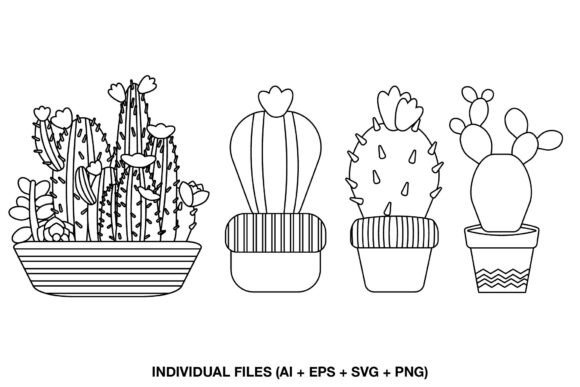
The moment I opened the folder, I noticed how quietly confident this graphic design asset feels. These aren’t cartoonish or overly stylized cacti—they’re clean, rhythmic line drawings with gentle tapering strokes, subtle asymmetry, and just enough organic variation to avoid feeling mechanical. The style leans into modern design without sacrificing charm: think Scandinavian simplicity meets Southwest warmth. It creates an immediate mood—calm, grounded, gently playful—that aligns perfectly with wellness, self-care, gardening, and slow-living brands.
Where It Shines in Real Client Work
In our succulent care kit project, Cactus Line Art Clipart became the visual anchor across multiple touchpoints. We used one of the four designs as a subtle background repeat on packaging tissue paper—scaled down, light gray, 15% opacity—adding texture without competing with the logo. Another cactus served as a standalone icon on the front label, paired with a clean sans serif font. Its high-resolution 300 DPI output held up flawlessly on matte-finish kraft boxes and glossy sticker sheets.
It performed equally well in digital spaces: resized for Instagram Stories (with soft drop shadow for readability), placed as a decorative accent in Canva templates for email newsletters, and embedded into a printable care guide PDF. For the client’s Cricut project library, we exported the PNG files with transparent backgrounds—tested and confirmed crisp on both vinyl and iron-on transfers. As a sublimation design, it printed cleanly on ceramic mugs and cotton tote bags without pixelation or stroke distortion.
This clipart also strengthened visual hierarchy in editorial design. In a blog post about “5 Easy Succulents for Beginners,” we paired one cactus illustration beside each tip—small but legible at 48px height—and it added rhythm and warmth without demanding attention away from the text. As a sticker design or t-shirt design, its minimal linework translates beautifully to screen printing and heat transfer applications.
Where to Use It Thoughtfully
While versatile, Cactus Line Art Clipart isn’t universally plug-and-play. Its delicate line weight means it loses definition below ~24px in web use—so avoid using it as tiny UI icons or fine-label accents on complex packaging. On busy backgrounds—especially textured paper mockups or photographic overlays—it needs careful contrast testing. We ran into issues when placing it directly over light beige linen textures without a subtle white stroke or soft shadow.
It’s also not ideal for minimalist corporate branding (think law firms or fintech) where ultra-refined geometry or monoline precision is expected. And while charming, it doesn’t carry the gravitas needed for luxury skincare or high-end apparel—its personality is inherently friendly and accessible, not austere or exclusive.
Designer Notes You Can’t Skip
Before deploying Cactus Line Art Clipart in any commercial design, here’s what I always verify:
- Test in black and white first—to confirm line integrity and ensure no strokes vanish at small sizes;
- Check contrast on both light and dark backgrounds, especially if planning social media graphics or website banners;
- Preview at actual usage scale: zoom to 100% in Illustrator, then export and view on mobile and desktop screens;
- Place on realistic product mockups—we used it on a matte mug and kraft box mockup before finalizing;
- Confirm print quality by ordering a test print on the exact paper stock your client will use;
- Review file formats: these are individual high-res PNGs—no SVG or layered PSD included, so editing flexibility is limited to raster adjustments;
- Inspect transparency: all PNGs have clean alpha channels—no fringing or anti-aliasing artifacts;
- Pair with typography intentionally: it harmonizes beautifully with rounded sans serifs (like Quicksand), friendly scripts (like Pacifico), and even restrained serifs (like Playfair Display)—but clashes with ultra-thin display fonts or rigid geometric typefaces;
- Verify commercial license terms: yes, this is a commercial license—fully cleared for client work, Etsy products, print-on-demand, and digital resale (e.g., as part of a Canva template or printable design bundle).
Final Verdict: A Reliable, Mood-Driven Creative Asset
Cactus Line Art Clipart isn’t flashy—but that’s its strength. In a landscape saturated with overdesigned, AI-generated clipart, its hand-guided rhythm and intentional simplicity make it feel human and trustworthy. For creative marketplace sellers, small business branding, seasonal campaigns, and printable design projects, it delivers consistent, scalable, emotionally resonant results.
It supports—not overshadows—the message. It enhances—doesn’t complicate—the layout. And because it’s built for coloring and creative projects, it invites customization: easy to recolor, layer, mask, or integrate into larger compositions without visual fatigue.
If your next client project calls for warmth, quiet confidence, and nature-inspired authenticity—whether it’s a handmade business launching its first product line or a blogger designing a Pinterest-worthy printable—it’s worth keeping Cactus Line Art Clipart in your active design assets rotation. Just remember: let it breathe, test early, and trust its quiet clarity.