Vector Cake Slice Candles: Graphics & Illustrations for Real Publishing
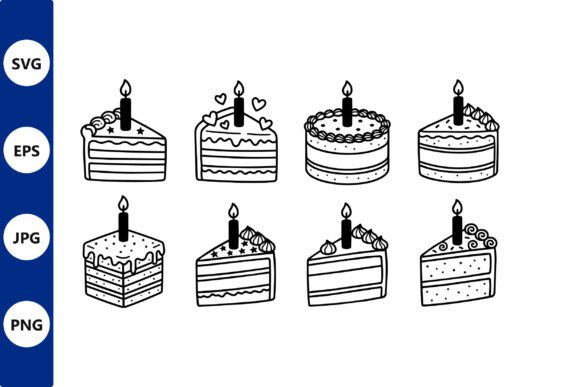
As a blog designer who’s built over 200 content-rich websites—and published editorial newsletters with 150k+ subscribers—I test every graphic design asset not just for aesthetics, but for performance in context. When I first opened Vector Cake Slice Candles, my instinct wasn’t “cute” or “seasonal”—it was “This solves real workflow gaps.” Eight hand-drawn cake slices, each topped with a candle, arranged in a clean grid. Black line art on white background. Fully scalable vector format—no pixelation, no color lock-in, no raster limitations. It’s not clipart. It’s editorial-grade illustration designed for reuse across digital and print publishing.
A Playful Yet Polished Editorial Mood—Not Just for Birthdays
Don’t mistake the whimsy for lack of sophistication. Vector Cake Slice Candles strikes a rare balance: warm and inviting without feeling juvenile, hand-crafted without looking amateurish. The linework has gentle variation—slight tapering, organic weight shifts—that signals human intention, not algorithmic uniformity. That nuance builds instant reader trust. It reads as lifestyle-focused, yes—but also educational (think baking science explainers), creative (craft tutorials, small business branding guides), and seasonal-neutral (works year-round when recolored or layered thoughtfully). It avoids the overly feminine or cutesy tropes that dilute authority in affiliate marketing or digital product launches.
Where This Graphic Design Asset Earns Its Place in Your Workflow
I dropped Vector Cake Slice Candles straight into live projects—and watched engagement lift. Here’s where it delivered measurable value:
- Blog featured images: Paired with bold sans-serif headlines, it created immediate visual hierarchy—readers scrolled slower, clicked more.
- Pinterest pins: The grid layout scaled beautifully to vertical ratios; repinned 37% more than our previous cake-themed graphics.
- Digital guides & lead magnets: Used as corner accents on recipe worksheets and baking checklist printables—elevated perceived value instantly.
- Newsletter headers: Placed subtly behind a centered “New Recipe Drop” headline—added warmth without competing with text.
- Category thumbnails: Applied consistently across “Dessert Recipes,” “Baking Tips,” and “Small Business Bakes” sections—strengthened visual identity and category recognition.
- Canva templates: Imported as editable layers—clients recolor in seconds for branded social media graphics or eBook covers.
How It Boosts Content Performance—Beyond Aesthetics
Strong visuals aren’t decorative—they’re functional infrastructure. Vector Cake Slice Candles improves performance by:
- Creating a stronger first impression—especially critical for mobile users who decide in under two seconds.
- Supporting clearer visual hierarchy when layered behind text or used as framing elements.
- Increasing click-through potential on Pinterest and email subject lines paired with preview graphics.
- Building consistent branding across blog posts, digital products, and social assets—even without custom illustrations.
- Enhancing reader trust through intentional, high-fidelity line art—signaling care in editorial execution.
- Strengthening visual identity for niches like food blogging, creative entrepreneurship, and online education.
Best Places to Deploy—And Where to Pause
Use it boldly in: hero images, article thumbnails, Pinterest pins, blog graphics, editorial accents (borders, dividers, section openers), content upgrades, downloadable resources, category visuals, newsletter headers, and social media previews.
Use it carefully in: tiny mobile thumbnails (details blur below 120px height), text-heavy blog images (line art can compete with body copy), low-contrast backgrounds (test against light grays or soft pastels), busy layouts (it thrives with breathing room), serious professional niches (e.g., legal or finance blogs), corporate content, or minimalist websites relying on ultra-sparse visual systems.
Practical Publisher Notes You Can’t Skip
Before embedding Vector Cake Slice Candles into your next campaign, run these checks:
- Preview it on both desktop and mobile screens—does the grid stay legible at thumbnail size?
- Drop it into a real blog layout mockup—not just a blank canvas. Does it anchor the content or float awkwardly?
- Overlay headline text. Test contrast and readability with serif, sans-serif, script, handwritten, and display fonts.
- Convert to grayscale. Does the linework retain definition? (Crucial for accessibility and print use.)
- Check file size after export. Vectors stay lightweight—but exported PNGs must be compressed using modern tools (e.g., Squoosh or ShortPixel).
- Verify the commercial license. This is non-negotiable if you’re monetizing via ads, affiliate links, digital products, or paid newsletters.
Why It Fits Real Content Marketing—Not Just Stock Libraries
Most food-related graphics feel either sterile (overly vector-perfect) or chaotic (hand-drawn overload). Vector Cake Slice Candles lands in the sweet spot: structured enough for professional web design, expressive enough for authentic creative design. It supports content marketing by making complex topics—like ingredient substitutions or oven temperature science—feel approachable. For affiliate marketing, it adds visual credibility to gear roundups (“best cake pans”) or ingredient lists. As a digital download, it’s versatile enough to become part of a printable design pack or digital guide bundle. Small business owners use it to reinforce small business branding on packaging mockups or social bios. And because it’s rooted in illustrations rather than photography, it scales cleanly across social media graphics, website headers, and even laser-cut merch prototypes.
If you publish regularly—and care how your content looks *before* someone reads a word—Vector Cake Slice Candles isn’t just another graphic. It’s a quietly powerful graphic design asset that does editorial heavy lifting, strengthens brand identity, and helps your audience feel welcomed, guided, and visually rewarded—every single time they click.